Exposure Measurement with a Digital Radiometer By Tina Scarpelli
Originally printed in Screenprinting Magazine and http://www.screenweb.com/prepress/cont/exposurez.htm
It isn't there anymore.
© ST Media Group International
Majestech's Ross Balfour uses a digital radiometer to calculate exposure times,
required exposure doses, and monitoring lamp performance. The data collected
from a number of test exposures can be used to calculate the exposure time for
future screens shot on any lamp and at any distance. The following describes
exposure tests he has run using this approach.
The tests involved screens coated 2+2 with an all-purpose, dual-cure emulsion
on 110 thread/in. yellow mesh. The light source was a 6000-watt multispectrum
metal-halide lamp at 60 in. from the screen. The photocell included a 365-nm
filter to match the absorption of the diazo sensitizer in the emulsion. After
placing the photocell behind the screen, the timer was set for 700 seconds,
a time known to be longer than the optimum. The exposure lamp was then turned
on and radiometer readings were charted.
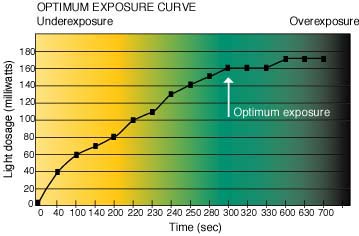
As the diazo reacts with the emulsion, it bleaches out and allows more light
penetration through the emulsion coating and onto the photocell in the radiometer.
As the exposure progresses, the radiometer registers the energy it sees in microwatts.
A leveling off of the readout indicates that the diazo is exhausted and exposure
is complete. The chart shown here illustrates the exposure curve for the stencils
in this test.
Balfour identifies optimum exposure as 160 milliwatts/300 sec, the point where
the curve levels off for the first time (although after awhile it did rise from
160 to 170). He notes that this just indicates the last of the diazo being "squeezed
out." At this exposure, he says, production screens made with the same screen
parameters should perform very well.
Balfour is a proponent of this method of exposure testing because it removes
the artwork from the equation, and concentrates solely on emulsion hardening.
"The danger with having an [exposure calculator] on the screen is that people
look at the detail they're getting," he says. "Then they'll automatically underexpose
to get the detail they didn't get at full exposure. It's a test. The fact that
you're not getting all the detail from the calculator image doesn't mean you're
not getting a good image."
Another problem with exposure calculators and control devices is density inconsistency.
I had 2-3 copies of several tools measured at a local service bureau, and the
variations ranged from 8-16 percent, meaning that two copies of the same tool
could give different readings on the same screen.
In addition to measuring exposure, the digital radiometer can be used to calculate
the required dose of energy for any mesh/emulsion combination. When light intensity
changes, the dose value can be used to calculate the new exposure time. The
formulas are as follows:
1. Dose (in mJ/cm) = Intensity x Exposure
2. Exposure = (Dose x 1000) / Intensity
Note: Intensity measurements are taken with a 405-nm filter in the photocell.
Exposure times can be converted to units if an integrator is used with the exposure
unit.
 Ross
Balfour is Research and Development Manager for Saatichem, a division of the worldwide
Saati Group of Companies. He directs and coordinates technical activities for
Saatichem’s multiple international locations from the company office in Mount
Prospect USA. Balfour has authored numerous articles and has been a frequent speaker
at industry events. He is a Graduate of the Royal Society of Chemistry in the
UK and has more than 20 years experience in the screen printing industry.
Ross
Balfour is Research and Development Manager for Saatichem, a division of the worldwide
Saati Group of Companies. He directs and coordinates technical activities for
Saatichem’s multiple international locations from the company office in Mount
Prospect USA. Balfour has authored numerous articles and has been a frequent speaker
at industry events. He is a Graduate of the Royal Society of Chemistry in the
UK and has more than 20 years experience in the screen printing industry.
I have lost track of Tina Scarpelli.